Project Report
| Nov 5, 2026
Somalia: "When the children eat, I eat last"
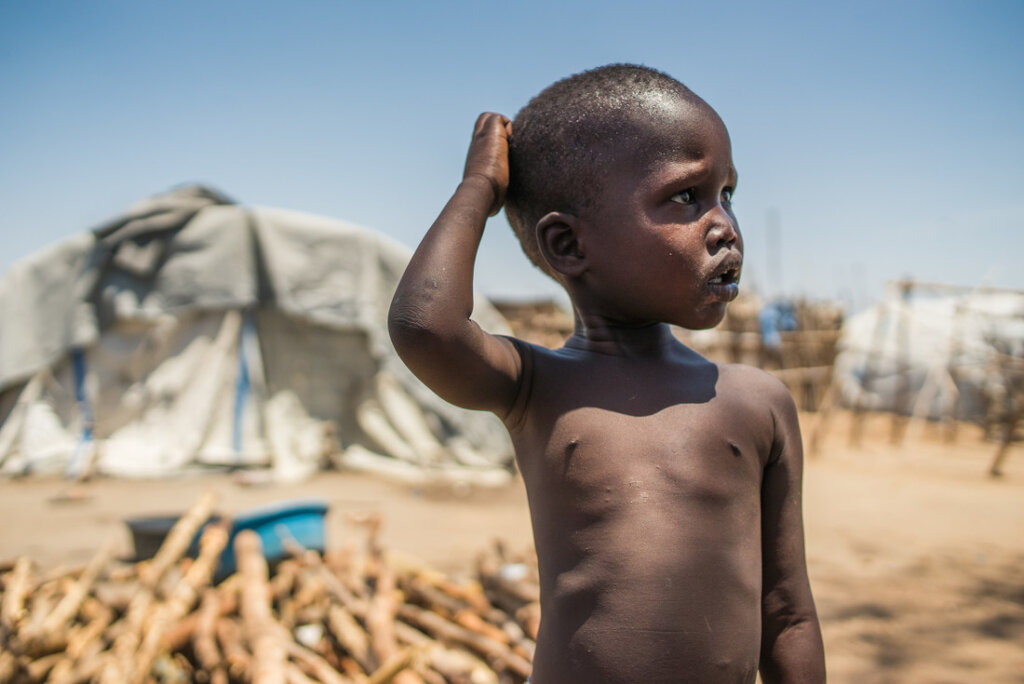
One-year-old Shukri holds her small cup
firmly in her hands and takes a cautious
sip of water. It is already afternoon;
for the little girl, this is her first
sip of the day. Her mother, Aisha, sits
beside her, watching. She herself has
not had anything to drink yet. "We
haven't eaten or had any water today,
because we have nothing," says the
35-year-old.

Aisha lives with her nine children in a
camp for displaced people near the
northern Somali town of Dhahar. Four
years ago, after her husband was killed
in an act of armed violence, the family
was forced to flee their home in
south-central Somalia. Subsequent fighting
later compelled them to flee once again.
Today, hunger and water scarcity threaten
their very survival.

Hunger defines daily life

The drought has hit the region hard. The
primary water source that once supplied the
area has dried up. Water trucks now dominate
the roads, transporting water but many
displaced families cannot afford it. This is
the case for Aisha and her neighbors. A single
jerrycan costs 0.20 US dollars a price that,
for Aisha, consistently translates into another
entry in the shopkeeper’s debt ledger. Yet, for
this mother, it remains the only way to provide
water for her children.
She straps the jerrycan to her back to carry it
home, and her children immediately gather
around it. Six-year-old Kawsar helps
three-year-old Adam take a drink.
Four-and-a-half-year-old Sahra waits with her cup,
ready for her turn.

Aisha herself does not drink. Children from
neighboring tents come running from all corners of
the camp, and Aisha shares the little that is
available. “Water is a major challenge, but food is
another. We are starving; there is nothing left here
for us to live on. We are simply waiting,” the mother
says. For her and her children, waiting has become
the only constant.

The Shoe-Shine Boys

To earn some money, her three eldest sons walk into
town every morning. They spend the day waiting in
public squares and near restaurants, hoping someone
will pay them to shine their shoes. Sometimes, they
bring home enough money for a bit of rice and some
tomatoes.

“But there are more days when we don’t even manage
to scrape that together. On bad days, we go to sleep
hungry and wake up even hungrier,” the mother says
quietly.

The Mother Goes Without

Whenever the family has something to eat, Aisha
ensures her children are fed first: “I give my
children food first and wait until they are full,”
she says. “Sometimes, there is nothing left for me.
But they are more important than I am.”

The consequences are visible. It is not just Aisha
who suffers from hunger; her youngest daughter,
Shukri, is also suffering from malnutrition.
Help for severe malnutrition

When a health worker from the alliance organization
of Aktion Deutschland Hilft, CARE, visits the camp,
she examines the children for signs of malnutrition.
She informs Aisha that she and her children can
receive free treatment at a health center in Dhahar;
the mother sets off immediately, accompanied by her
daughter, Shukri.

At the health center, she receives care and is
provided with Plumpy’Nut, a therapeutic food. Aisha
is also given a bottle of water, which she drinks her
first water of the day, late in the afternoon. For Aisha
and her daughter, this support is a matter of survival.

An uncertain future

Across Somalia, an estimated 6.5 million people are
suffering from acute hunger, as drought, conflict, and
economic hardship continue to drive up humanitarian needs.
Families who have been forced to flee conflict and crises,
in particular, struggle every single day to find enough
food and clean water.

However, humanitarian aid is under pressure. A lack of
funding threatens the continuation of vital health and
nutrition programs. Without this support, Aisha is left
with the same waiting that defines every day in the
camp: waiting for rain, waiting for work, waiting for
water, waiting for food.

Thank you for helping the people of
Somalia with your donation!
![Share on Twitter]()
![Share on Facebook]()