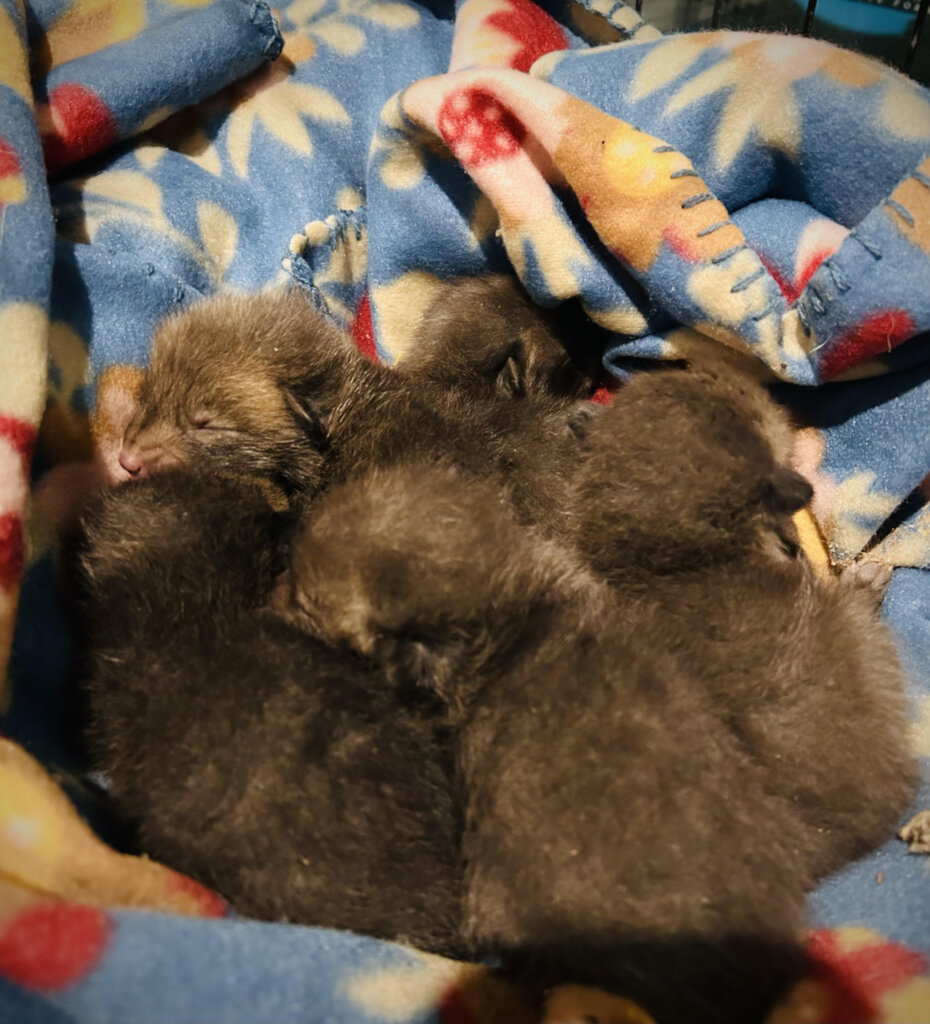
Despite being late bloomers, as you'll soon learn about, they arrived quite early in our baby season. Patients 26-377 and 26-378 arrived at RWS in mid-May as wee little fluffballs. The first was discovered by a rescuer’s son while walking through the woods in Shenandoah County, with no nest or mother in sight. The second was found alone on the ground in a driveway in Rockingham County.
A week later, we admitted yet another orphaned baby Eastern Screech-Owl – and this patient had an even wilder rescue story. A family in Augusta County was driving when a baby owl suddenly fell out of a tree above them and onto their car! Somewhat miraculously, the little owl did not endure any serious injuries. This owlet joined our growing cohort of screech-owls at the Sanctuary and became patient 26-443.
All three owlets started out in our nursery incubator. This specialized setup keeps hatchlings toasty while they grow the plumage needed to properly thermoregulate. During this time, we tong-fed each baby multiple times throughout the day, ensuring each chunk of mouse was carefully "de-boned" just like mom and dad would do for these little ones in the wild. Luckily, we do not have to use our mouths like mom and dad would for that process. Phew.
A critical goal throughout raptor rehabilitation is preventing imprinting. This is an irreversible learning process during which a young bird learns to identify with its own species, usually thanks to a same-species caregiver's presence. Whether that psychosocial switch flips correctly to "owl" or incorrectly to "human," it cannot be undone. We avoid imprinting by, well, avoiding these babies! We enforce a strict silence rule whenever we have raptor patients in our wildlife nursery, and we keep their enclosures covered to prevent them from peeking out at our team as we treat other patients nearby. If we have a lone raptor in care, we also provide that patient with a mirror so it's looking at "a friend" of the same species.
Preventing imprinting also involves fashion. Our rehabbers don super stylish camouflage hunting hoods to completely cover our faces, and we use thick gloves while tong-feeding to avoid exposing any skin.
After about three weeks in our nursery, the teeny trio was beginning to look less like a puddle of fluff and more like three beautiful young owls. It was time for them to graduate to an outdoor enclosure! In our smaller flight enclosure, the owls could stretch out their wings and leave us beautiful pellets as they began eating whole prey.
Eastern Screech-Owls are fascinatingly complex patients to care for due to their natural history. These fierce predators are also prey animals! Though they have evolved to have sharp talons, a tearing beak, and excellent hunting skills like their fellow raptor species, they are also teeny – which means they look like a delicious snack to many larger species.
We often see their natural defense mechanisms develop when we have Eastern Screech-Owls in care. These patients rely on their excellent camouflage to protect themselves, raising their ear tufts to appear larger and closing their eyes so they look like just another bit of bark on a tree. Our team was delighted to watch these three patients demonstrate this defensive behavior from the moment they moved outdoors to a flight enclosure!
Despite their excellent camouflage skills, the owlets were not-so-excellent at something pretty darn important to their survival: flying! These owlets were inexplicably slow to take to the skies despite enrichment designed to encourage them to fly. At one point, they even became a bit too chunky thanks to their lack of enthusiasm for exercise. (We get it. ) Repeated physical exams revealed no evidence of injury or illness that could explain their slow progress.
So, we were patient! After a month outdoors, we finally started to see their first trepidatious flights. Their pectoral muscles were well-developed, and they were able to smoothly avoid obstacles mid-flight. PHEW.
The timing actually ended up being perfect. (What do you call an owl who's always on time? Punctu-owl!) By the time these three juvenile screech-owls were ready to graduate to our largest flight enclosure, the previous residents – a squad of Red-shouldered Hawks – had just been released! We have just one flight enclosure at RWS that is truly suitable for raptor patients. We operate on a pretty quick turnover schedule, moving patients in as soon as space becomes available. The owlets took to their new digs beautifully, showing off their flying skills and continuing to strengthen their flight muscles over the summer months.
But as they neared their own release, yet another critical skill proved slow to develop for these late bloomers: they could not figure out how to hunt. Kind of important for a raptor.
For all obligate carnivore patients, like these owls, the final step of their release-readiness evaluation is to pass Mouse School. We prepare a large tub inside the flight enclosure with plenty of substrate for digging, hidey-holes, food, water, and enrichment before placing 2–3 mice from our on-site colony inside. Then, we set up a game camera and monitor the footage for evidence of successful hunting.
We know it sounds like a morbid process, but it is simply not an option to rehabilitate predators without ensuring they can secure food for themselves in the wild. We all adore mice here at RWS and truly cherish the opportunity to rehabilitate native mice. In that same vein, we are grateful to be able to maintain our own small breeding colony of non-native mice to incorporate into Mouse School. These mice are beloved members of the RWS team who are playing a vital role in our work as rehabbers, and so we treat them like the royalty they are! Our mouse colony residents receive daily doting care and enrichment like any other animal in care.
Back to the three stooges: for weeks, these owlets simply could not get it together. We'd watch them on the game camera footage as they perched on the edge of the tub all night, staring at the mice without making a move. Still, we could find no evidence of an underlying medical issue affecting their ability to hunt, including problems with their hearing or vision. We reduced their supplemental feedings to encourage them to hunt independently, but this final hurdle continued to elude them. Until...
Finally, just this past week: HUZZAH! All three owlets demonstrated successful catches, bringing us one enormous step closer to their return to the wild. (We think the accompanying photo of one particularly shocked-looking owl clutching its mouse says it all.)
Though we love seeing patients develop at an efficient pace, this trio has reminded us that late bloomers are still worth every ounce of our effort at the Sanctuary. Their care journey proves that no rehab protocol is a one-size-fits-all process! Individualized care adjustments, frequent observation, and patience – lots of patience – are vital to our wildlife rehabilitation work.
Though patients 26-377, 378, and 443 may have taken the scenic route to independence, we were thrilled to see them finally putting their skills to the test. We released them in late October!
Thank you for reading about our quarterly report! Your support makes every patient's care possible – especially when they take their sweet time.